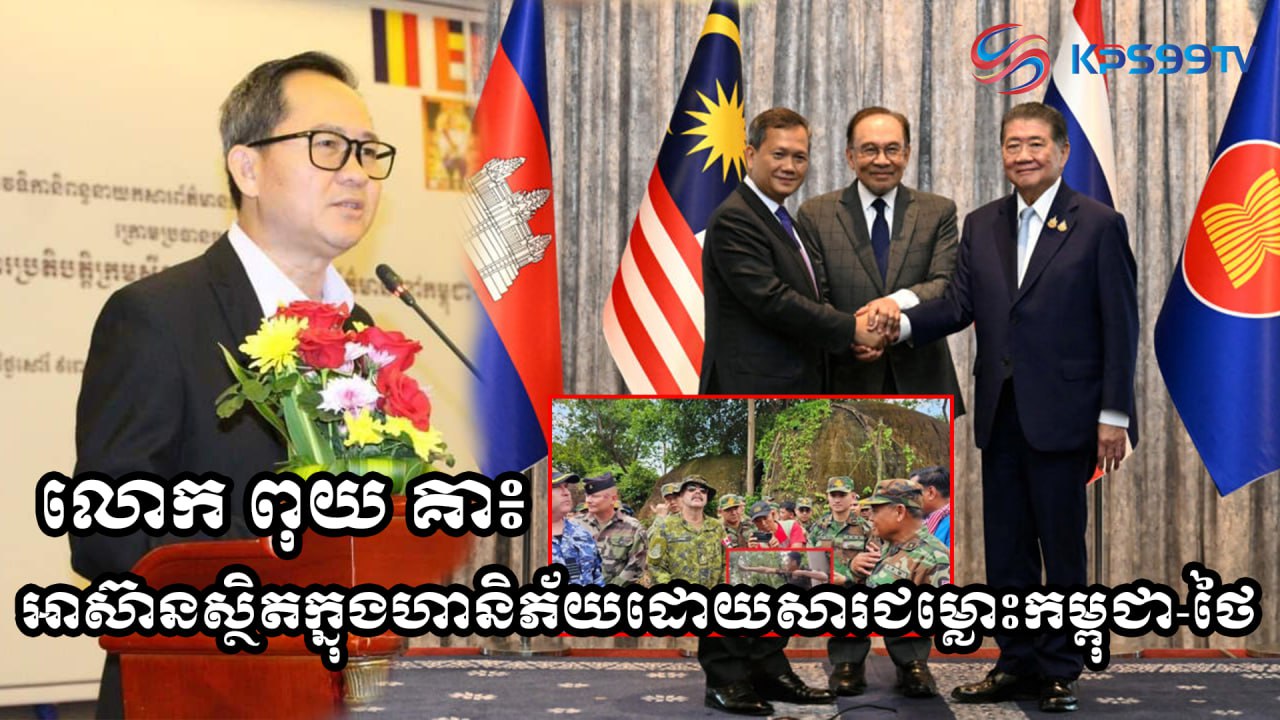
PHNOM PENH — This commentary argues that the Cambodia–Thailand border conflict, renewed after a Cambodian soldier was shot dead by Thai troops in Preah Vihear’s three-border area on May 28, 2025, threatens the 58-year-old ASEAN bloc. The author warns that prolonged hostility could undermine regional stability.
The author argues that Thai military actions along the border and against Cambodian civilians could erode ASEAN’s credibility as a community built on cooperation, trust and peace.
According to Cambodia’s Ministry of Foreign Affairs statement of September 17, 2025, Prime Minister Hun Manet wrote to world leaders including US President Donald Trump and Chinese President Xi Jinping, saying Thai forces had expanded their actions beyond disputed areas in Preah Vihear and Oddar Meanchey into other provinces.
Hun Manet’s letter said: “Since August 12, Thai forces have extended the conflict by laying barbed wire, installing barriers and issuing ultimatums to expel Cambodian residents from their long-established homes in ជោគជ័យ and ព្រៃចាន់ villages, Banteay Meanchey province, in northwestern Cambodia, approximately 200 kilometres from the disputed areas mentioned above. Twenty-five Cambodian families have been prevented from returning to their homes and farmland. A Thai military spokesman recently threatened further expulsions that could affect several hundred families with more than 1,000 people.”
The letter added: “According to reliable sources, Thai forces intend to use force to seize land at 17 other locations, from Pursat to Koh Kong in western and southwestern Cambodia.”
Do Thailand’s actions demonstrate ASEAN solidarity?
For decades ASEAN has promoted a vision of “one community”. The author argues that when two member states clash, the bloc’s non-interference principle leaves it paralysed and unable to decide as one family.
A weak ASEAN mediation role:
The article says Cambodia has appealed to the UN Security Council, major powers including the United States and China, and the 2025 ASEAN chair, while Thailand insists on bilateral settlement. The author argues that failure to restrain Thai actions shows the Treaty of Amity and Cooperation and the ASEAN Charter have not been effective.
ASEAN loses face:
The commentary says Thailand used F-16 fighters, drones and heavy artillery, killing and injuring Cambodian civilians and displaced people and causing destruction. It cites observers warning that such violence could damage ASEAN’s reputation as a stable, peaceful region and undermine foreign investor confidence.
ASEAN’s agenda risks stagnation:
The article argues that the conflict could weaken trust among leaders and disrupt economic integration, infrastructure projects and the South China Sea code of conduct. Analysts cited warn that prolonged tensions could slow regional economic integration and let outside powers divide ASEAN; the author places responsibility on Thailand.
Effects beyond the battlefield:
The article says bilateral trade and tourism have already been disrupted. Rising nationalism is tightening cross-border relations and harming the people-to-people ties on which the ASEAN community depends.
Is it time for ASEAN reform?
The crisis has renewed debate over ASEAN’s conflict-management capacity. Analysts cited argue that without stronger mechanisms, ASEAN could lose its centrality in regional security. Others see the conflict as a wake-up call to strengthen institutions and recommit to peaceful dispute resolution.
The author concludes that these concerns should enter the ASEAN and related summits in Kuala Lumpur, Malaysia, in the coming weeks. Questioning the relationship between Thailand’s government and military, the commentary asks how ASEAN should engage Thailand and whether it should regard it as another military-ruled Myanmar. This is the author’s question, not a finding that Thailand has become a military government.
By ពុយ គា, President of the Club of Cambodian Journalists